3. When BMX says no
What this is for
Markdown has one property that everybody likes and nobody examines: it never fails.
Whatever you give it, something comes out. That is genuinely lovely when you are typing a comment into a text box. It is a different thing entirely when the document was generated, or edited by somebody in a hurry, or written by a program.
The wrong kind of forgiving
Here is a document that got truncated — a network hiccup, a script that stopped, a copy-paste that took nine lines of ten:
# Invoice 4417

Thank you for your order. Your balance is **£240.00
Markdown renders that. The page goes out looking almost right:
Invoice 4417
Thank you for your order. Your balance is **£240.00
A stray pair of asterisks. Somebody notices next week, or nobody does.
BMX stops:
BMX-E002 at 46: unterminated strong
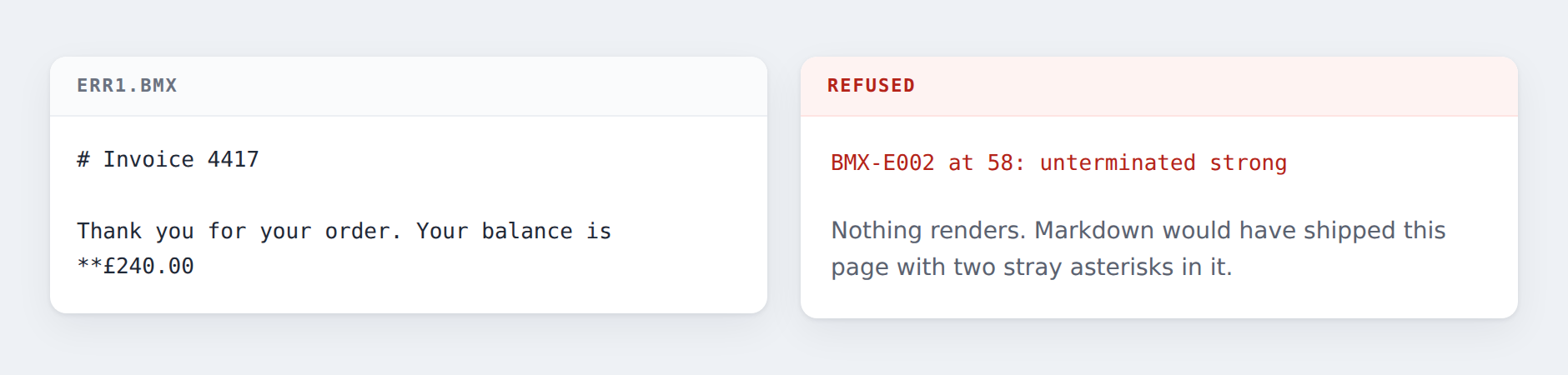
Nothing renders. The build fails, the job fails, and you find out at the moment the document was wrong rather than at the moment a customer reads it.
Autocorrect and spellcheck
This is the whole distinction, and it is worth holding on to.
Autocorrect decides what you probably meant and changes it. It is right most of the time, and when it is wrong it is wrong silently — you find out when somebody replies to your message confused.
Spellcheck stops and points. It costs you a second. It never quietly changes what you said.
Markdown is autocorrect. BMX is spellcheck. Neither is better in the abstract; they are for different situations. The situation BMX is built for is the one where a document might not have been written by a careful human, and the cost of a page that looks nearly right is somebody’s money or somebody’s afternoon.
Every refusal has a code
Not a stack trace, not a guess — a code, a position, and a sentence:
BMX-E011 at 0: a heading needs exactly one space after its #
The code is the part that is the same in every implementation of BMX, in every language. So a
build script can key on BMX-E011 and keep working when you switch renderers.
Here are the ones you will actually meet:
| You wrote | You get |
|---|---|
#Heading |
BMX-E011 — a heading needs one space after its # |
a *bold sentence |
BMX-E002 — unterminated emphasis |
Hi {{ name |
BMX-E001 — unterminated slot |
see [docs](x |
BMX-E004 — unterminated link target |
an indented - item |
BMX-E012 — 0.2 has no list nesting |
a \q b |
BMX-E021 — only ` * [ { \ may be escaped |
:card: never closed |
BMX-E031 — unterminated block, and it names the closer it wanted |
:9lives: |
BMX-E030 — a block name is a letter, then letters, digits, - and _ |
The full list has one entry for each, with the input that produces it.
Why #Heading is an error
This one surprises people, so it is worth doing properly.
#Heading
Markdown reads that as a paragraph that happens to start with #. Reasonable! And it means a
missing space silently demotes your heading to body text — same file, different meaning, no
warning. You get a page where one heading is mysteriously not a heading.
BMX will not choose for you. One space after the #, or say what you meant.
The same reasoning covers the rest: when a document could mean two things, BMX asks rather than picks. Every place that feels strict is a place where markdown quietly decided something.
It stops at the first one
You get one error, not a list. That is deliberate for now: reporting every error at once means guessing how to carry on past the first, and two implementations that guess differently would disagree about a document — which is the entire thing this format exists to prevent.
Better diagnostics are a real want and they are on the list. Being wrong together is not.
Next: Views that check themselves — where the document stops being text and starts being checked code.